A new air conditioning system installed in a Peoria, Arizona home comes with manufacturer documentation suggesting a service life of 15 to 20 years. Experienced Peoria homeowners know that this figure rarely holds in the desert Southwest. The gap between the published number and the real-world service life in Peoria is not a product quality problem. It is a climate operating conditions problem: the assumptions embedded in manufacturer lifespan estimates do not reflect what happens to an AC system that runs 2,000 to 2,500 hours per year in sustained outdoor temperatures that routinely exceed 110 degrees Fahrenheit.
What “15 to 20 Year Lifespan” Actually Assumes
AC manufacturer lifespan estimates are based on average expected operating conditions across the range of climates where the equipment is sold. The national average for residential AC operating hours is approximately 750 to 1,000 hours per year, reflecting a typical seasonal cooling pattern in temperate markets that includes a spring ramp-up, a summer peak, and a fall ramp-down across a four-to-five-month cooling season.
In this usage pattern, a system accumulates 750 to 1,000 annual operating hours on its compressor, fan motors, capacitors, contactors, and refrigerant circuit seals. Manufacturer estimates of 15 to 20 years imply a total operating life of 11,250 to 20,000 hours before end-of-life failure rates become significant. These are reasonable estimates for the national average climate. They do not describe what happens in Peoria.
Peoria’s Annual Operating Hours vs. the National Average
Peoria sits in the northwest Phoenix metro at roughly 1,100 feet elevation, with a climate essentially identical to Phoenix proper. The cooling season in Peoria runs from late April through mid-October, approximately seven months of active daily cooling demand. During peak summer from late May through mid-September, an AC system in a standard Peoria home runs 10 to 14 hours per day maintaining indoor temperatures against outdoor highs of 105 to 115 degrees Fahrenheit.
This produces annual operating hours of 2,000 to 2,500 in a typical Peoria installation, two and a half to three times the national average. At 2,500 hours per year, a Peoria AC system accumulates 11,250 to 20,000 total operating hours, the equivalent of the full national lifespan estimate, in four and a half to eight years. The practical consequence is a realistic Phoenix-area lifespan of 8 to 12 years rather than the 15 to 20 years on the documentation. A 10-year-old Peoria AC system has experienced the equivalent mechanical stress of a 20 to 25-year-old system in a temperate climate.
Haboob Season Coil Loading and What It Does to Compressor Longevity
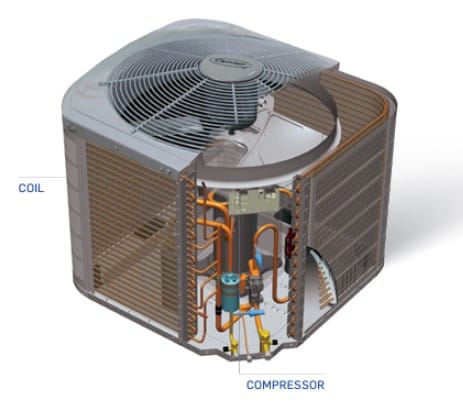
Operating hours alone explain much of the compressed Peoria AC lifespan, but haboob season introduces an additional degradation factor that national average estimates do not account for at all. Peoria’s spring and early summer period from April through June brings multiple haboob events that deposit silica particulate on the condenser coil fins of every outdoor unit in the city. A condenser coil coated with haboob dust cannot transfer heat from the refrigerant to the outdoor air as efficiently as a clean coil.
The consequence of reduced condenser heat rejection is elevated refrigerant head pressure, which forces the compressor to work against higher discharge pressure to complete each refrigeration cycle. Operating at elevated head pressure accelerates wear on compressor valve assemblies, increases electrical current draw, and raises the operating temperature inside the compressor itself. All of these effects shorten compressor service life beyond what the operating hours alone would predict. A Peoria compressor that operates through four to five haboob seasons without condenser coil cleaning has experienced stress conditions that a compressor in a dust-free climate of equivalent hours would not have encountered.
The Monsoon Season Effect on Condensate Systems
Peoria’s monsoon season, which runs from mid-June through September, introduces a third specific challenge for AC systems: dramatically increased condensate production. During Phoenix-area monsoon events, outdoor relative humidity spikes from the typical 5 to 15 percent to 50 to 70 percent within hours. An AC system running during this humidity event removes moisture from indoor air through condensation on the evaporator coil, and the volume of water produced during a high-humidity monsoon event can be three to five times the condensate volume produced during normal dry-climate operation.
Condensate drain lines sized for normal Phoenix dry-season condensate production may be partially inadequate during monsoon season peaks, particularly if biological growth from previous seasons has partially restricted the drain pathway. Condensate drain overflow produces water damage to ceiling materials below the air handler location, requires immediate HVAC service, and can trigger system shutdown if an overflow sensor is installed and functioning. Annual condensate drain service before monsoon season is the preventive step that addresses this specific Peoria seasonal failure mode.
Maintenance Intervals That Match Peoria’s Real Operating Conditions
A Peoria homeowner who follows national recommendations of AC service every two to three years is effectively maintaining a system that ages at 2.5 times the national rate on an interval designed for the national rate. The more appropriate maintenance interval for Peoria and the broader Phoenix metro is annual professional service, scheduled in February or March before the haboob and monsoon seasons begin and before peak summer demand compresses technician availability.
Annual service in Peoria should specifically address condenser coil cleaning after the previous haboob season, capacitor testing to identify borderline components before peak summer failure, condensate drain flushing before monsoon season increases production, and refrigerant pressure measurement to identify any slow-leak trends before they affect cooling performance during the hottest weeks of the year. The cost of annual professional maintenance across the 8-to-12-year Phoenix lifespan of a properly maintained system is substantially less than the additional service calls and premature replacement that deferred maintenance produces.
For Peoria homeowners recalibrating their maintenance expectations to match local operating conditions rather than national averages, exploring resources on air conditioning in Peoria, AZ that reflect the West Valley’s specific climate provides the most relevant guidance for managing system longevity in a climate where a 10-year-old AC system is not middle-aged but approaching the end of its working life.