
To start a pest control business, get certified as a pesticide applicator in your state first, then form the company and apply for the state business license, buy insurance and equipment, set recurring prices, set up scheduling and treatment records, and market to local homeowners and businesses. Licensing usually takes the longest, so start there.
Pest control is a good business to start because customers come back. A homeowner who signs up for quarterly service in spring is often still a customer years later. The flip side is regulation. You handle restricted chemicals in other people’s homes, so every state controls who can do it and how.
How to start a pest control business, step by step
The table shows the usual order. Your state may combine or add steps, so confirm each one with your state’s pesticide regulator before you spend money.
| Step | What it involves | Who you deal with |
|---|---|---|
| 1. Applicator certification | Training, exams in the categories you will treat | State pesticide regulator, usually the department of agriculture |
| 2. Business structure | LLC or corporation, EIN, bank account | Secretary of state, IRS |
| 3. Pest control business license | Company license tied to a certified applicator | State pesticide regulator |
| 4. Insurance | General liability, pollution liability, commercial auto, workers’ comp | Insurance agent who covers pest control |
| 5. Vehicle and equipment | Sprayers, dusters, bait stations, PPE, secure chemical storage | Suppliers, distributors |
| 6. Services and pricing | Which pests, residential or commercial, initial plus recurring price | Your own market research |
| 7. Scheduling and records | Routes, service agreements, treatment records, invoices | Field service software |
| 8. Marketing | Website, Google Business Profile, reviews, referrals | Local customers |
Get the pest control business license first
States regulate pesticide use under federal rules, and each state’s lead agency (most often the department of agriculture) issues the licenses. There are usually two layers. An individual license certifies that a person can apply pesticides commercially in specific categories, such as general household pests, termites or lawn and ornamental. A business license allows a company to sell pest control services, and it normally requires a certified applicator on staff.
Some states require documented experience under a licensed operator before you can hold the business license, and most require continuing education to renew. Check this first, because it can decide whether you start the company now or work for another operator for a while. Your state regulator’s website lists the categories, exam schedules and study materials.
Insurance, vehicle and equipment
General liability insurance covers damage or injury at a customer’s property, and many commercial clients will not sign without a certificate. Pollution liability covers claims tied to the chemicals themselves, which standard policies often exclude. Add commercial auto insurance for the truck and workers’ compensation once you hire.
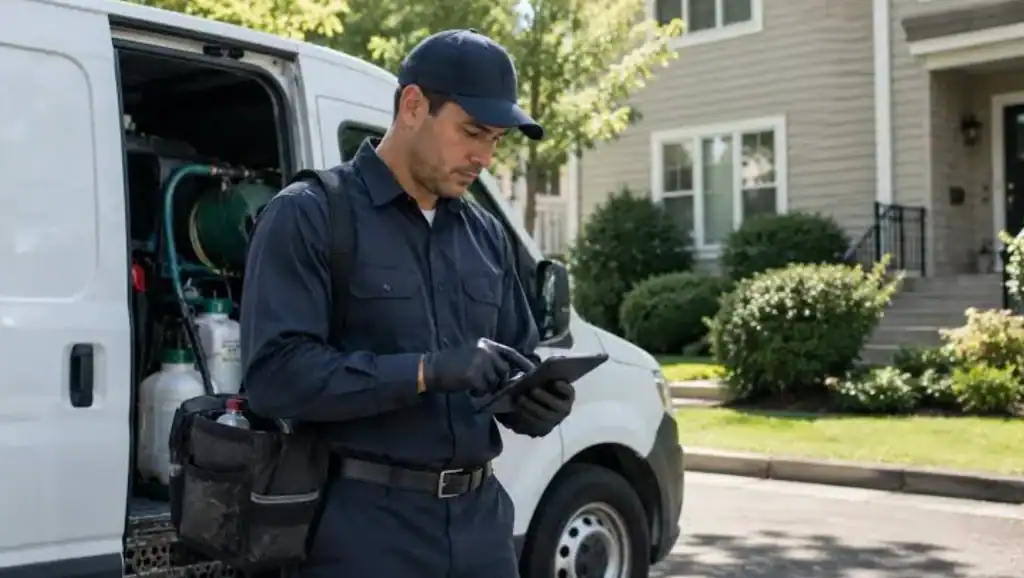
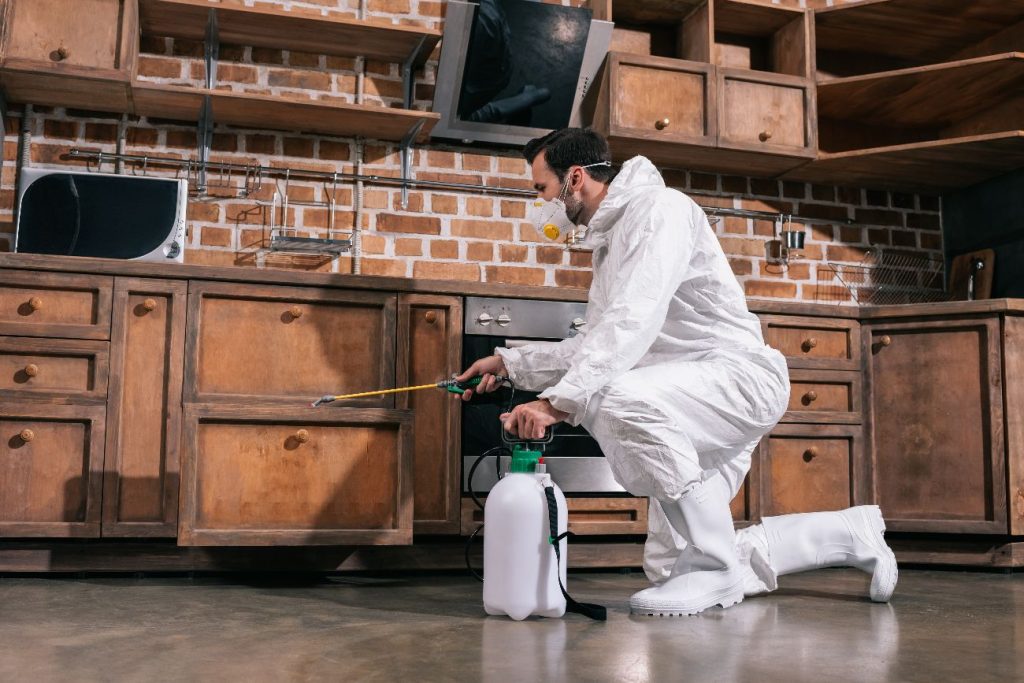
The starting equipment list is short. You need a backpack or hand sprayer, a power sprayer for exteriors, a duster, bait stations, a moisture meter and flashlight for inspections, and personal protective equipment. The vehicle needs secure, labeled storage for chemicals that meets your state’s rules. Buy for the services you will actually sell, and add termite or wildlife equipment later.
Choose services and a pricing model
Most new companies start with general residential pest control, because it has the most demand and the simplest treatments. Termite work, rodent exclusion, mosquito programs and commercial accounts can follow once you hold the right license categories and have some experience.
The pricing model matters more than the price. Residential pest control is usually sold as an initial service, which costs more because it treats an established problem, followed by a recurring service, most often quarterly. The recurring service agreement is what makes a pest control business valuable, because each customer pays several times a year with no new marketing cost. Price the initial visit to cover your time and product, and price the recurring visits so a full route of them is profitable.
Modern pest control also relies on integrated pest management, which combines inspection, prevention and targeted treatment rather than spraying on a calendar. The EPA’s principles of integrated pest management are worth reading before you write your service descriptions, because many commercial clients ask for an IPM approach.
Set up scheduling, routes and treatment records
Recurring customers need a system from day one. Every quarterly visit has to be scheduled, grouped into efficient routes and recorded. Most states require pesticide application records, including the product, its EPA registration number, the amount used, the location and the date, kept for a set period.
A spreadsheet works for the first dozen customers. After that, missed renewals, unbilled visits and incomplete records start to cost money. Most owners move to field service software that schedules recurring visits, builds routes and stores the treatment record on each property. Look for pest control invoicing software that bills each recurring visit automatically and records the products used, so billing and compliance come from the same visit.
Find your first customers
Your first customers are almost always local. Start with a simple website that lists your services, service area and license number, and set up a Google Business Profile so you appear in map results. Ask every early customer for a review, because reviews decide which company a homeowner calls.
Then build from there. Door hangers in neighborhoods where you already service homes make routes denser. Real estate agents, property managers and landlords send steady work. Commercial accounts such as restaurants and offices need documented IPM programs, but they pay monthly. Over time, organic search becomes the cheapest source of new customers, and SEO for pest control companies is what moves you from the second page of results to the map pack in your town.
FAQ
Are pest control businesses profitable?
They can be, mainly because of recurring revenue. Quarterly service agreements bring repeat payments from the same customers without new marketing, and dense routes keep drive time low. Profit depends on pricing, route density and keeping customers year after year.
Do I need a license to start a pest control business?
Yes. Every state requires commercial pesticide applicators to be certified, and most also license the business itself. Contact your state’s pesticide regulator, usually the department of agriculture, for the exact requirements.
What are the steps of IPM?
The EPA describes four main steps, which are to set action thresholds, monitor and identify pests, prevent them, and control them with the most effective, lowest-risk method first.