African honey bees can often be removed alive, including colonies nesting inside roofs and walls. Live bee removal aims to resolve the problem at your property while preserving the colony. Here is how it works and what to know before arranging a removal.
Finding bees at your home does not automatically mean they need to be exterminated. In many cases, an experienced beekeeper can collect the bees, remove accessible comb and relocate the colony to a suitable hive.
Need help with bees on your property in Gauteng? Contact Bee Removals to discuss live removal and request a quote:
Understanding African Honey Bees
The African honey bee, Apis mellifera scutellata, is native to much of South Africa, including Gauteng. These bees pollinate flowering plants and crops and are kept by beekeepers for honey production.
They can also defend their nests vigorously when disturbed. A colony that appears quiet outside a roof or wall may react quickly when someone opens its nesting space.
This defensive behaviour makes proper equipment and experience important. It does not mean the bees cannot be relocated alive.
Is It a Visiting Swarm or an Established Colony?
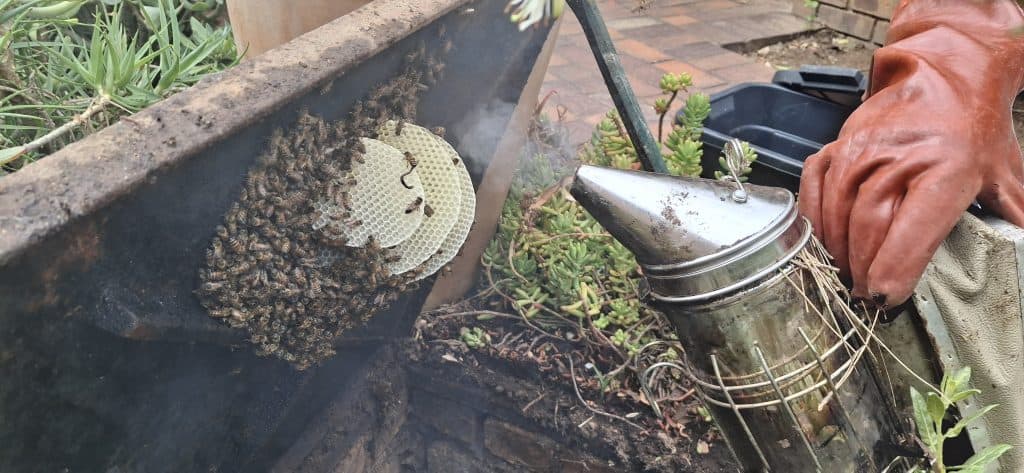
A cluster of bees hanging from a branch may be a travelling swarm resting while scout bees search for a suitable home. If it has not built comb, collecting it is often more straightforward than removing an established nest.
Bees repeatedly entering a hole in a wall, roof or meter box may already have settled inside. An established colony builds comb containing honey, pollen and brood, which are the developing young bees.
The visible entrance can be small even when the nest behind it is substantial. Collecting a few bees outside or blocking the opening will not resolve the colony inside.
How Are the Bees Removed Alive?
The beekeeper first assesses the nesting location, how it can be reached and the risk to people and animals nearby. An exposed swarm in a low tree requires a different approach from a colony concealed behind a ceiling.
For an established nest, reaching the bees may involve lifting roof tiles or opening part of a wall or ceiling. The beekeeper collects the bees into suitable equipment and removes accessible comb. Where appropriate, viable brood comb can be supported in hive frames to help preserve the colony.
Keeping the queen with the colony is an important part of the process. The removal also needs to account for workers that are away foraging, so timing and possible follow-up visits matter.
The collected bees are then relocated to a suitable beekeeping site. The aim is to give the colony an opportunity to settle into a managed hive and continue functioning.
Why Does Comb Removal Matter?
Removing bees from a building is only part of the work. Honey and comb left inside a roof or wall can attract insects and create further problems.
Ask the beekeeper what can be removed and whether any comb extends into inaccessible spaces. The amount of work required depends on the structure and the position of the nest.
It is also worth confirming who will repair any roof, ceiling or wall sections opened during removal. Building repairs may be separate from the bee removal service.
Once the work is complete and the beekeeper confirms it is appropriate, suitable entry points can be closed to reduce the chance of another swarm moving in. Never seal an entrance while an active colony remains inside.
What Should You Do While Waiting for Help?
Keep children and pets away from the nesting area and avoid disturbing the bees. Do not spray the colony, try to smoke it out with a fire or break open the space where it is nesting.
When contacting a removal service, explain where the bees are entering, approximately how high the entrance is and how long you have noticed them. Mention any insecticides or other treatments already used.
A photograph can help with the initial assessment, but only take one from a safe position. You do not need to approach the entrance or open the nest to obtain a quote.
What Should You Ask a Bee Removal Service?
Confirm that the proposed service involves live removal and relocation. Ask what will happen to the collected colony, whether access to the nest requires structural work and what the quote includes.
A clear assessment should explain any limitations. Bees deep inside a chimney or an inaccessible cavity may require additional access before the beekeeper can confirm a suitable approach.
Can Every Bee Be Saved?
Live removal aims to preserve the colony, but it cannot guarantee that every individual bee survives. Access difficulties, the condition of the colony and previous pesticide exposure can affect the outcome.
African honey bees do not have to be killed simply because they have settled in an inconvenient place. A professional assessment can establish whether the colony can be removed alive, helping you address the problem while giving the bees a chance to continue living elsewhere.